
West-bugwe_mc

From Conflict to Coexistence in Uganda’s Forest Communities

For Uganda’s forest-edge communities, West Bugwe forest is a source of life, but it can also be a hostile and fearsome place. Although the forest canopy used to be a lush oasis, much of the native tree cover has been destroyed, replaced by the invasive Paper Mulberry (Broussonetia papyrifera) and dense, cumbersome shrubbery. The equatorial sun beats down on a raucous cawing of Black-and-white-casqued Hornbills (Bycanistes subcylindricus) and the chattering of Red-tailed Monkeys (Cercopithecus ascanius). Cicadas drone, while the Red-capped Robin-chat (Cossypha natalensis) whistles a rich song full of mimicry. Groups of children and women laugh and shout to each other while collecting firewood, their voices quieting when they encounter a stranger.  

On days like this, too many people have been killed by venomous snakes or harassed by aggressive primates, among other dangerous or fatal wildlife encounters. Meanwhile, the National Forest Authority has been tasked with protecting the forest from illegal activities, but many community members feel disconnected from their efforts. To break this cycle of fear and conflict, A Rocha Uganda is bringing everyone to the table to share the forest in peace. 

Green Bush Viper in West Bugwe Forest, Uganda

Life in the Forest 
 After surveying the forest’s wildlife, A Rocha Uganda identified 14 snake species across the landscape. 64 percent of these were venomous, including the Green Bush Viper (Atheris squamigera), whose leaf-textured scales help it blend into the forest’s understory. An encounter with these snakes at home or in the forest can be incredibly dangerous: A Rocha found a complete absence of antivenom at local health facilities, as well as delayed interventions and limited community awareness of how to safely respond to snake encounters.   

Surveys also confirmed the presence of four primate species, including the nationally vulnerable De Brazza’s Monkey (Cercopithecus neglectus). Its presence indicates that the reserve is still able to support species with specialized ecological requirements. This underscores the importance of conserving the few mature forest sections that remain. De Brazza’s Monkey prefers dense, riverine forest habitats and is generally elusive. Nevertheless, community members have reported regular conflict, including almost daily crop-raids by monkeys and especially the more brazen Olive Baboons (Papio anubis). 

Promoting Co-existence 

Protecting West Bugwe begins with education and empowerment. A Rocha Uganda brought the National Forest Authority, Collaborative Forest Management groups (CFMs), forest guards, churches and students together for a forest conservation workshop. There, leaders were equipped with the skills to identify species, understand forest ecology, and promote coexistence between humans and wildlife.  

This was followed by surveys of the wider community to understand better how and why conflict with wildlife happens. It often takes the form of crop raiding, snake bites, livestock predation and safety concerns for women and children. Using these responses and other Ugandan models, A Rocha hosted wildlife coexistence workshops in local schools, churches, trading centres and CFM groups.

Olive Baboon in West Bugwe Forest

These interventions have already begun to transform people’s relationships with the forest’s wildlife. One CFM member explained, ‘Before the training, we feared snakes and would kill them immediately. Now I know which ones are dangerous and what to do safely.’ Community members have a greater understanding of the vital ecological roles of snakes and primates, and they are equipped with non-lethal strategies to avoid conflict.  

Gathering ‘headloads’ of firewood from West Bugwe Forest

Conflict isn’t just limited to wildlife. Historically, the National Forest Authority (NFA) has contended with illegal activity in the forest, especially around restoration areas. A Rocha Uganda’s interventions have improved relationships: people have begun attending local meetings and engaging with the Forest Authority in and around the forest. As active routes into the forest close, compromises are found. For example, thanks to A Rocha Uganda’s mediation, the NFA now allows community members to enter the forest one day a week to collect a ‘headload’ of firewood: the amount they can physically carry on their heads.  

Restoring the forest for people and wildlife 

A Rocha Uganda has also been allocated 50 hectares of the forest to restore, and they are bringing the community alongside this work. While the forest canopy appears intact, much of it has been ravaged by invasive species like Paper Mulberry (Broussonetia papyrifera) and Lantana Camara. A Rocha’s restoration is taking two forms: reforestation of native tree species and liberation of native seedlings that are already established by intervening to encourage their growth.  

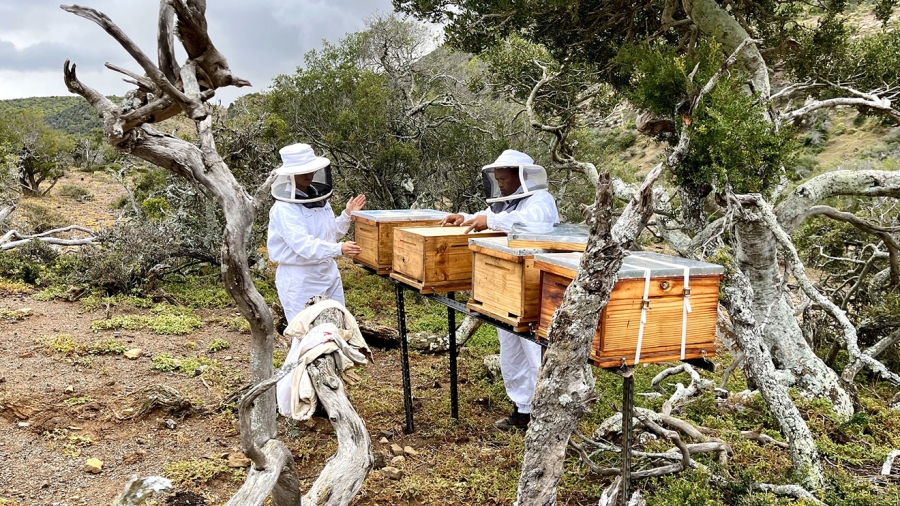
Sustainable livelihoods are an essential component of West Bugwe’s long-term conservation: A Rocha Uganda is equipping local households with techniques like beekeeping, Farming God’s Way, agro-forestry, and building smokeless stoves. All of these activities reduce pressure on the forest while enriching communities’ connections with the natural environment.  

These interventions are proving to be a good witness of A Rocha’s Christian faith. A local church in Habuleke has observed an increase in membership as the community sees its relevance due to the accrued benefits from forest honey production livelihood.  

Peter Ejakait showing his success with Farming God’s Way

In another town, Hamuli, Peter Ejakait is a leader of the Collaborative Forest Management group and a practitioner of Farming God’s Way. This includes three basic principles – zero-tillage, mulching and rotation of crops – which mimic natural forest ecosystems. Since switching to this form of conservation agriculture, Peter has increased his agricultural yield immensely. Through education and community-based conservation, properties like Peter’s and the forest itself are growing into an oasis. West Bugwe is becoming a place where both humans and wildlife can thrive.  

Earth-Raise_mc

Our conservation works

We’re excited to let you know we have been selected to participate in the Big Give’s Earth Raise 2026 (formerly Green Match Fund).

Protect, observe, inspire. 

A Rocha’s approach to conservation works. We’ve learned that over 40 years. Our projects help protect threatened ecosystems and species like the endangered Sokoke Scops Owl Otus ireneae, Africa’s smallest owl, and heavily trafficked pangolins. We carefully observe the natural world through scientific monitoring. This constant learning informs improvements to management plans and leads to new conservation approaches. Finally, we inspire others to take action through our education programmes, publications, messaging, engagement with churches, and plastic reduction projects. 

Our Earth Raise campaign will raise money to protect over 300 species, 1 million hectares of land, run scientific learning exercises to improve best practice and then inspire over 7,000 people to take action. 

Earth Raise begins at noon (GMT) on #EarthDay, 22 April and continues until noon on 29 April. During that time, every contribution made through our campaign page on the Big Give website* will be DOUBLED. 

One donation, double the difference. 

* Please note only donations made through our campaign page on the Big Give website between 22-29 April are eligible to be doubled (while match funds last). The donate button will appear on the campaign page when Earth Raise launches. 

Photo: Eelgrass survey in Boundary Bay, Canada by Hannah Mae Rose

Fox-Earth-Meadow_mc

Foxearth Meadows nature prescription

Foxearth Meadows Nature Reserve in Essex has been run by A Rocha UK for just over 10 years now. Andy and Sarah (Foxearth Meadows team) comment that visitors often speak about the calm they feel the moment they step onto the reserve. The stillness, the birdsong, the gentle movement of water. It’s a place where shoulders drop and breathing slows. 

Experience has shown that time in nature can be powerful for people who are feeling isolated, overwhelmed or simply worn down. That’s why Andy and Sarah reached out to the local GP practice, hoping the reserve could become part of the community’s wellbeing support. 

It worked. Foxearth Meadows is now officially listed as a social-prescribing activity. When someone visits their GP feeling lonely, anxious or in need of gentle movement, the social-prescribing team can suggest a walk at the reserve or an invitation to join the Friday Volunteer Group. It’s a simple step that can make all the difference, a chance to meet new people, to move a little more and to feel grounded again. 

The team isn’t told who comes to Foxearth Meadows through this pathway, and their names may never be known. But this much is clear: week by week, a quiet stream of people arrives at Foxearth Meadows. Some come for a walk; some stay to help. All leave having felt the gift of peace the reserve provides. 

ARO Welcome_Nigeria_mc

Welcome A Rocha Nigeria

Join us in welcoming A Rocha Nigeria to the A Rocha Worldwide Family – a new chapter emerging from the faithful work of Eden Creation Care Initiative.

One of its flagship projects has been caring for the Rennajj Fish Farm for several years. In the heart of Jos, in Plateau State, abandoned ponds and a threatened wetland habitat is now a landscape alive with restoration.

Each morning, as mist rises gently from the water, the protection team walks the boundaries, boots pressing into damp earth, watching for signs of disturbance and ensuring wildlife is undisturbed. As the dry season approaches, careful hands carve firebreaks across the land, tracing protective lines against wildfire. When the rains return, pond outlets are sealed, allowing water to gather and remain, sustaining life long after the clouds have passed.

Nearby, a nursery hums with quiet growth. Thousands of seedlings of cashew and other native species stretch toward the sun, waiting to take root in renewed soil. Over time, hopeful saplings have matured. African baobab and African locust bean trees now stand tall, their fruit a living testimony of resilience.

Invasive eucalyptus trees are gradually replaced with native, life-giving species. Along the edges, Jatropha curcas – a drought resistant, perennial plant – forms a living fence, guarding the sanctuary.

As Eden transitions into A Rocha Nigeria, this flourishing wetland becomes part of a global family – locally rooted, globally connected and thriving with hope.

ARO Welcome_DR Congo_mc

Welcome A Rocha DR Congo

The Democratic Republic of Congo is known both for its extraordinary biodiversity and for the long shadow cast by conflict. Decades after one of Africa’s most devastating civil wars, over 7 million people remain displaced, and localized struggles over land and resources continue to fracture daily life. The minerals that power much of the modern world are pulled from Congolese soil, and the cost is borne by communities and ecosystems alike.

Into this fragile, vibrant place steps a new member of the A Rocha family: A Rocha DR Congo was founded as TRAFFED in 2003 in Bukavu, South Kivu. For more than 20 years, TRAFFED has quietly and faithfully woven together creation care, community development and Christian discipleship in some of the world’s most challenging contexts.

Their work stretches across eastern Congo’s globally significant landscapes, from community forests on Mount Kabobo to conservation efforts protecting Grauer’s Gorilla Gorilla beringei graueri in the Itombwe region. The team partners with pastors to address deforestation around Kahuzi-Biega National Park, supports women’s eco-entrepreneurship across South Kivu, and advocates for sustainable fisheries near Lake Albert. At the heart of it all is a deep commitment to faith: biblical teaching integrated into conservation, churches equipped as agents of hope, and collaboration across evangelical and ecumenical lines.

One of A Rocha DR Congo’s most inspiring achievements is the Higher Institute of Ecology for Conservation of Nature, home to a pioneering department of environmental theology, forming leaders who see creation care as central to God’s purposes.

In a place marked by long conflict and loss, A Rocha DR Congo reminds us that faithful action is still possible. As Steve Tanner, board chair of A Rocha International writes, ‘This new member of the family represents a huge sign of hope. Even in countries in conflict, where the population goes through extreme difficulties, dangers and uncertainties, there are Christians who chose to stand up and act for creation. A Rocha DR Congo joining the family is a powerful encouragement!’

Bitterns_mc

Booming Bitterns return

Bitterns prefer to be heard, not seen. Camouflaged in streaked brown plumage, this heron haunts the reedbeds of freshwater or brackish marshes. When it feels threatened, the Bittern freezes and extends its neck towards the sky, a position it can maintain for several hours. It will even sway, mimicking the movement of the wind in the reeds, waiting for the danger to pass. This long neck is also a formidable weapon, tucked into its shoulders as the Bittern moves imperceptibly towards a fish, amphibian or aquatic insect. Once it is close enough, it extends its neck to catch or pierce its prey with its spear-like beak. Due to its stealthy nature, it is difficult to detect a Bittern’s presence by sight, but its deep, rhythmic call can be heard from hundreds of metres away.

For the first time in over 30 years, the booming of the Eurasian Bittern Botaurus stellaris has been heard once again in the marshes of the Baux Valley, France. By surveying an area from dusk until dawn during breeding season, the A Rocha France team identified a singing male in the Ilon Regional Nature Reserve on several occasions. Since this species is polygamous, it is likely that there are also several females on the site. The Bittern’s return to the valley is encouraging news, suggesting that the water levels and environments are favorable to its nesting.

In Aotearoa / New Zealand, the Karioi Project is a collaborative community restoration initiative supported by A Rocha Aotearoa / New Zealand, contributing to the Matuku-hūrepo Muster: a national initiative to monitor and protect the Australasian Bittern / Matuku-hūrepo Botaurus poiciloptilus. Local wetland surveys and community hui (gatherings) are helping build a clearer picture of where these elusive birds are breeding, the habitats on which they rely and how better to support their survival. This work also raises awareness of the value of healthy wetlands for people and wider biodiversity around Whāingaroa and beyond. In 2024 and 2025, 14 sites were monitored by listening, with five Bitterns recorded booming across four sites.

Listen to the striking call of these delightful creatures below. Through strategic conservation work, we hope to have wetlands resound with Bittern booming once again!

Eurasian Bittern Botaurus stellaris recorded by A Rocha France in the Valleé de Baux. 
Eco-Church_mc

The global Church cares for creation

Christians around the world are embracing the call to care for God’s world, and creation care programmes are taking root in their churches. While A Rocha UK’s iconic Eco Church network turns ten this year, new programmes are emerging throughout the A Rocha Worldwide Family, each with a unique flavour based on the country, cultureand needs of the local church.  

At the end of 2025, A Rocha Lebanon partnered with the Middle East Council of Churches to launch Eco Church Middle East, a programme that spans from Morocco to Iran. Eco Church will reach more than 20 Christian traditions in the region – including Catholic, Orthodox and Protestant groups – with materials available in at least five languages.  

Similar in scope, the new Eco Church Australia covers a vast area of the country, which includes a wide range of climates and ecosystems from desert to tropical rainforest. This means that the most sustainable approaches and priorities will differ between churches, but planting indigenous plant species for native bees, birds and other wildlife will be a priority everywhere.  

Eco Church / ‘Eco Igrejas’ has also sprouted in Portugal, leading to an unprecedented cooperation between the Roman Catholic majority, Evangelical and Historic Protestant churches. Representatives from these groups are all coming together on the Eco Church team. The project also makes a deliberate and unique effort to use language that is shared and accessible across these different Christian traditions. 

In the United States, Christians are not necessarily known for caring for creation. A Rocha USA is challenging this through Churches of Restoration. Rev. Sarah Robinson, pastor at Audubon Park Covenant, explains her approach: ‘Beyond just simply loving what God loves, we were created out of the earth and dependent on it.’ See how church members are responding in the video below.

Eco Eglise’ invites Christians in Switzerland to evaluate the ‘frenetic pace’ of modern lifestyles and embrace the long, slow work of creation care. Through gardens, seasonal celebrations, reducing waste and sourcing food locally, among many other actions, Swiss Eco Churches present an alternative and intentional way of living with God’s creation.  

In New Zealand, the Eco Church Network is called ‘whānau’, a Māori word for an extended family group. It’s an invitation for churches and creation to journey together as kin. This ecumenical, nationwide movement seeks to care for God’s earth, with a special emphasis on art and storytelling alongside practical action. Similarly, A Rocha Ghana’s Eco Church programme emphasizes ‘being a friend to the environment’, equipping churches to demonstrate their care for God’s creation within their worship, their church compound and the community around them. 

Since A Rocha UK and their partners launched Eco Church in 2016, over 9,000 churches have joined – around 23% of churches across England and Wales! Over 4,500 churches have achieved Eco Church awards, with initiatives like buzzing biodiversity gardens, outdoor services in nature, sharing low-mile food items, and making historic buildings climate-smart.  

Micah-Global_mc

Micah Global conference

At the end of September last year, over 230 people gathered in Cape Town for the Micah Consultation. Each day began with vibrant ululations of worship in Zulu and Xhosa – an amazing expression of faith that set the tone for the days ahead. It was a privilege to witness how faith brings together people from diverse cultures and organizations: those providing relief, running toward crisis, caring for vulnerable communities, and protecting creation. The four days were deeply rooted in shared knowledge, reflection, and prayer for every person present. 

For the first time, the Micah Consultation included a Creation Care track, led by A Rocha’s Dave Bookless and Kuki Rokhum, alongside Laura Yoder from Wheaton College. 

With the magnificent Table Mountain as our backdrop, the creation care team set out to experience God’s beauty firsthand, sitting on the rocks at Kalk Bay as waves crashed against the shore, and enjoying a surprise visit from a friendly seal at the harbour. We also heard powerful local stories of resilience, including efforts to protect green spaces such as Princess Vlei Park, where communities stood firm against plans to convert the land into shopping malls or residential developments. 

Throughout the consultation, conversations revealed the deep pain many carry from the work they do. Dave offered a reflective presentation on lament that brought a fresh and transformative perspective to many.  

‘Tears are the seeds on which hope can grow,’ he said. It was a powerful reminder of what can emerge from brokenness, drawing us back to hope and faith. 

The women of Micah also spent a full day at Intaka Island, engaging with one another. They spoke honestly about the gender-specific challenges they face and explored ways to navigate and mitigate them. Women in leadership encouraged those just beginning their journeys not to give up, even when the path feels lonely. 

Renowned Filipina writer Melba Maggay left us inspired with these words: ‘Do not think of your empty spaces as a place of deprivation, but as a place of consecration.’ 

ICUN-Panel_mc

IUCN World Conservation Congress: panel discussion

In October 2025 the IUCN World Conservation Congress brought together governments, NGOs, Indigenous people groups and volunteer scientists who are working urgently to protect nature and conserve life on Earth.  The Congress is responsible for shaping the global conservation agenda and as the only global Christian Conservation organization, we brought a distinctive perspective. 

We held an event last November to hear reflections and observations from A Rocha delegates Avinash Krishnan, Judith Ochieng and Ed Walker about the purpose and impact of the congress, which you can watch below. 

Big-Give_mc

Big Give

Double your impact

We’re excited to let you know that in 2026, with your help, we hope to mobilize and equip over 35,000 young people to care for creation. Every region of the world is experiencing acute crises of biodiversity loss and climate change. Species and habitats, tropical forests and reefs are being lost daily. Temperatures are rising while governments cut funding for conservation programmes. With their futures at stake, young people care deeply about the state of the world and want to contribute to solutions. However, they can be paralyzed by eco anxiety, lack relevant training or simply don’t know where to begin.    

Investing in young people has always been an important part of the A Rocha mission. We have been selected to participate in the Big Give Christmas Challenge again and this year your support will help us reach even more young people through Environmental Education programmes, internships, volunteer placements, capacity building and youth-led research projects. Your gift will equip young people to understand better the connection between creation care and the Christian faith. Reaching this many young people would make a significant impact and we’d love your support.   

The Christmas Challenge kicks off at noon (GMT) on #GivingTuesday, 2 December and continues until noon GMT on 9 December. During that time, every contribution made through our campaign page on the Big Give Christmas Challenge website* will be DOUBLED.  

One donation, twice the impact.  

*Please note that only donations made through our campaign page on the Big Give website between 2-9 December are eligible to be doubled (while match funds last). The donate button will appear on the campaign page when the Christmas Challenge launches.