Blog_Federica-Marsi_mc

Anchored To The Rock

Federica Marsi

Anchored To The Rock

An A Rocha Story Of Redemption.

A journey from loss, loneliness, and doubt to faith, belonging, and hope through discovering community and the unexpected anchor of Christ.

I first reached the white sandy beaches of A Rocha Kenya feeling like a shipwrecked person –looking for firm land under my feet and something to quench the thirst.  

Then, in February 2021, my life had just been through a year-long storm.  

A long-term relationship collapsed under a pile of half-truths and deceits, just as the global pandemic confined me into an empty apartment in Milan, Italy. 

With travels suspended, my freelance journalistic work in the Middle East ground to a halt. In the first days of the pandemic, when northern Italy replaced China as the epicentre of the outbreak, I went out reporting from overwhelmed intensive care units and improvised field hospitals.  

But in a few weeks’ time, the news cycle had moved on and newspapers started slashing budgets amid global economic uncertainty. As work dried out, loneliness crept in. So did self-doubt, and shame for my 34-year-old single, unemployed self.  

One year into my solo lockdown, I resolved to find myself a lifeline. I will never be able to piece together how I came to book a one-way ticket to Nairobi in the midst of a pandemic, beyond that I was craving nature and had come across a documentary on Kenyan wildlife.  

"One year into my solo lockdown, I resolved to find myself a lifeline."

Upon arrival, I signed up for a safari and then set out to explore the country all the way to the coast. On a booking website, I spotted an accommodation advertised as a “Christian conservation centre”. Nature conservation work sounded just right for me, but the Christian part made me hesitate. I certainly did not want to risk my sunset beer.  

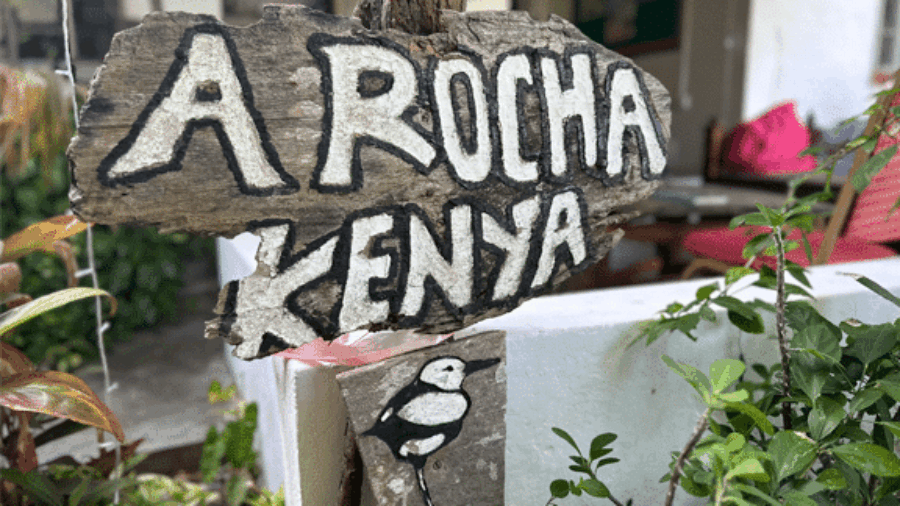
I resolved to stay only three nights. But as I was given a brief tour of the environmental field study centre at A Rocha Kenya – or as Kenyans call it, “Mwamba” – I had a strong feeling of being in the right place. Such foreboding does not go unnoticed when you’re someone who second-guesses every decision, so I asked if I could stay as a volunteer.  

Community life came as a gulp of water. Gathered around the same table were people from the four corners of the world whose love for nature made any land their home. Over a shared meal, I would learn about the resilience of pocket-sized birds as they fly intercontinental for thousands of kilometres or learn what turns bright-coloured corals a pale, ghostly white. Most of all, I relished in the shared sense of purpose, the awe-fillness of every discovery, the selflessness with which everyone offered to wash my dishes, and each and every soul-nurturing word of kindness.

Among them was Amanda, a British woman about my age who was volunteering alongside her husband. We had little in common and our interactions remained sparse and polite, until the day I noticed her sitting alone, visibly flustered.

Tears ran down her face as she confided in me that her marriage was falling apart. The storm of sorrow and grief that roiled inside her felt all too familiar.

"At A Rocha, I had hoped to find myself but found much more."

But something was oddly different in her turmoil. I sensed no self-deprecation, guilt or shame. Albeit disoriented, she had what struck me as an unrelenting hope for the future.

Her anchor in the storm, she said, was the God of Christianity, and I — rather mercilessly — proceeded to question her belief system from what I considered to be a rational standpoint.  

Whenever she didn’t have an answer — or, perhaps, was running short of her bountiful patience — she would simply reply: “that’s a good question, why don’t you go and look it up?’ And so I went down the rabbit hole of research, as fast as only a journalist can.  

Three months in, on one of my last days at A Rocha Kenya, I received the news that my grandmother had died. As I mourned, I joined the service held by Colin Jackson, the founder of A Rocha Kenya.  

Colin stayed behind at the end of the gathering to listen to me as I wrestled with my doubts on life after death, on good and evil, on my own existence — and, ultimately, the existence of God.  

He shared his own life-shattering sorrows and how God had walked with him through them. It was there, as he spoke words of truth on a rooftop overlooking the sea, that the veil dropped and I came to believe.  

At A Rocha, I had hoped to find myself but found much more.  

I found a community, which I have been back to visit twice. Once, in 2023, with Amanda, who baptised me in the Indian Ocean alongside Colin. The second in 2025, shortly after marrying the love of my life, Giuseppe.  

Most importantly, I came to know Jesus, to know I am loved, and that I am enough. He’s been my anchor ever since.  

Federica Marsi

Federica is a news producer with Al Jezeera and a journalist covering migration and environmental issues.

Other Articles

West-bugwe_mc

From Conflict to Coexistence in Uganda’s Forest Communities

For Uganda’s forest-edge communities, West Bugwe forest is a source of life, but it can also be a hostile and fearsome place. Although the forest canopy used to be a lush oasis, much of the native tree cover has been destroyed, replaced by the invasive Paper Mulberry (Broussonetia papyrifera) and dense, cumbersome shrubbery. The equatorial sun beats down on a raucous cawing of Black-and-white-casqued Hornbills (Bycanistes subcylindricus) and the chattering of Red-tailed Monkeys (Cercopithecus ascanius). Cicadas drone, while the Red-capped Robin-chat (Cossypha natalensis) whistles a rich song full of mimicry. Groups of children and women laugh and shout to each other while collecting firewood, their voices quieting when they encounter a stranger.  

On days like this, too many people have been killed by venomous snakes or harassed by aggressive primates, among other dangerous or fatal wildlife encounters. Meanwhile, the National Forest Authority has been tasked with protecting the forest from illegal activities, but many community members feel disconnected from their efforts. To break this cycle of fear and conflict, A Rocha Uganda is bringing everyone to the table to share the forest in peace. 

Green Bush Viper in West Bugwe Forest, Uganda

Life in the Forest 
 After surveying the forest’s wildlife, A Rocha Uganda identified 14 snake species across the landscape. 64 percent of these were venomous, including the Green Bush Viper (Atheris squamigera), whose leaf-textured scales help it blend into the forest’s understory. An encounter with these snakes at home or in the forest can be incredibly dangerous: A Rocha found a complete absence of antivenom at local health facilities, as well as delayed interventions and limited community awareness of how to safely respond to snake encounters.   

Surveys also confirmed the presence of four primate species, including the nationally vulnerable De Brazza’s Monkey (Cercopithecus neglectus). Its presence indicates that the reserve is still able to support species with specialized ecological requirements. This underscores the importance of conserving the few mature forest sections that remain. De Brazza’s Monkey prefers dense, riverine forest habitats and is generally elusive. Nevertheless, community members have reported regular conflict, including almost daily crop-raids by monkeys and especially the more brazen Olive Baboons (Papio anubis). 

Promoting Co-existence 

Protecting West Bugwe begins with education and empowerment. A Rocha Uganda brought the National Forest Authority, Collaborative Forest Management groups (CFMs), forest guards, churches and students together for a forest conservation workshop. There, leaders were equipped with the skills to identify species, understand forest ecology, and promote coexistence between humans and wildlife.  

This was followed by surveys of the wider community to understand better how and why conflict with wildlife happens. It often takes the form of crop raiding, snake bites, livestock predation and safety concerns for women and children. Using these responses and other Ugandan models, A Rocha hosted wildlife coexistence workshops in local schools, churches, trading centres and CFM groups.

Olive Baboon in West Bugwe Forest

These interventions have already begun to transform people’s relationships with the forest’s wildlife. One CFM member explained, ‘Before the training, we feared snakes and would kill them immediately. Now I know which ones are dangerous and what to do safely.’ Community members have a greater understanding of the vital ecological roles of snakes and primates, and they are equipped with non-lethal strategies to avoid conflict.  

Gathering ‘headloads’ of firewood from West Bugwe Forest

Conflict isn’t just limited to wildlife. Historically, the National Forest Authority (NFA) has contended with illegal activity in the forest, especially around restoration areas. A Rocha Uganda’s interventions have improved relationships: people have begun attending local meetings and engaging with the Forest Authority in and around the forest. As active routes into the forest close, compromises are found. For example, thanks to A Rocha Uganda’s mediation, the NFA now allows community members to enter the forest one day a week to collect a ‘headload’ of firewood: the amount they can physically carry on their heads.  

Restoring the forest for people and wildlife 

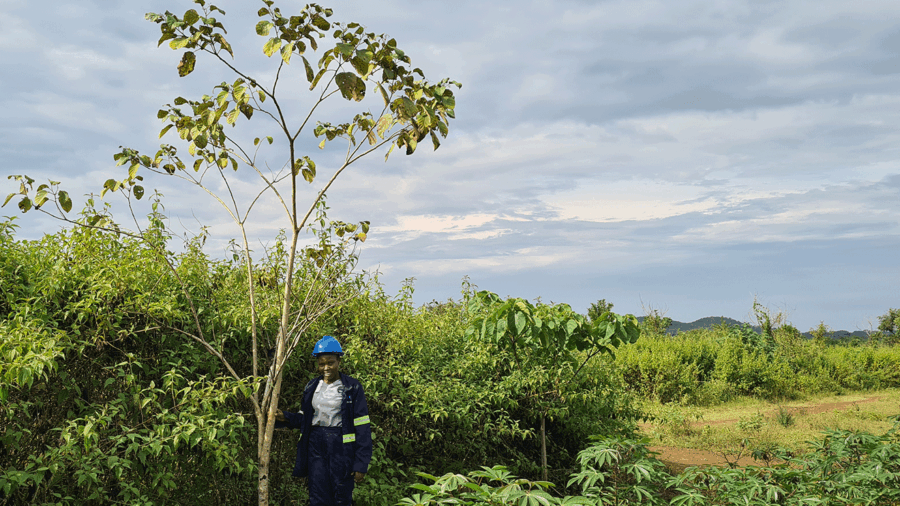
A Rocha Uganda has also been allocated 50 hectares of the forest to restore, and they are bringing the community alongside this work. While the forest canopy appears intact, much of it has been ravaged by invasive species like Paper Mulberry (Broussonetia papyrifera) and Lantana Camara. A Rocha’s restoration is taking two forms: reforestation of native tree species and liberation of native seedlings that are already established by intervening to encourage their growth.  

Sustainable livelihoods are an essential component of West Bugwe’s long-term conservation: A Rocha Uganda is equipping local households with techniques like beekeeping, Farming God’s Way, agro-forestry, and building smokeless stoves. All of these activities reduce pressure on the forest while enriching communities’ connections with the natural environment.  

These interventions are proving to be a good witness of A Rocha’s Christian faith. A local church in Habuleke has observed an increase in membership as the community sees its relevance due to the accrued benefits from forest honey production livelihood.  

Peter Ejakait showing his success with Farming God’s Way

In another town, Hamuli, Peter Ejakait is a leader of the Collaborative Forest Management group and a practitioner of Farming God’s Way. This includes three basic principles – zero-tillage, mulching and rotation of crops – which mimic natural forest ecosystems. Since switching to this form of conservation agriculture, Peter has increased his agricultural yield immensely. Through education and community-based conservation, properties like Peter’s and the forest itself are growing into an oasis. West Bugwe is becoming a place where both humans and wildlife can thrive.  

Earth-Raise_mc

Our conservation works

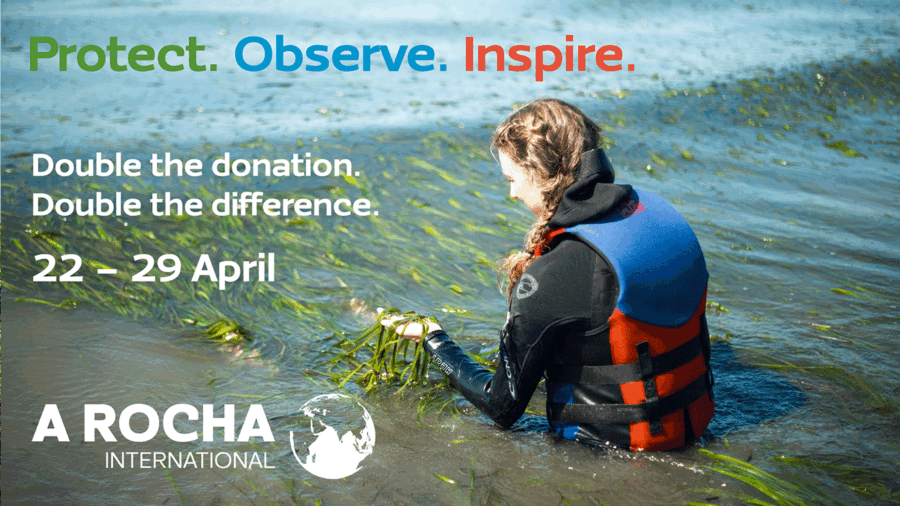
We’re excited to let you know we have been selected to participate in the Big Give’s Earth Raise 2026 (formerly Green Match Fund).

Protect, observe, inspire. 

A Rocha’s approach to conservation works. We’ve learned that over 40 years. Our projects help protect threatened ecosystems and species like the endangered Sokoke Scops Owl Otus ireneae, Africa’s smallest owl, and heavily trafficked pangolins. We carefully observe the natural world through scientific monitoring. This constant learning informs improvements to management plans and leads to new conservation approaches. Finally, we inspire others to take action through our education programmes, publications, messaging, engagement with churches, and plastic reduction projects. 

Our Earth Raise campaign will raise money to protect over 300 species, 1 million hectares of land, run scientific learning exercises to improve best practice and then inspire over 7,000 people to take action. 

Earth Raise begins at noon (GMT) on #EarthDay, 22 April and continues until noon on 29 April. During that time, every contribution made through our campaign page on the Big Give website* will be DOUBLED. 

One donation, double the difference. 

* Please note only donations made through our campaign page on the Big Give website between 22-29 April are eligible to be doubled (while match funds last). The donate button will appear on the campaign page when Earth Raise launches. 

Photo: Eelgrass survey in Boundary Bay, Canada by Hannah Mae Rose

Fox-Earth-Meadow_mc

Foxearth Meadows nature prescription

Foxearth Meadows Nature Reserve in Essex has been run by A Rocha UK for just over 10 years now. Andy and Sarah (Foxearth Meadows team) comment that visitors often speak about the calm they feel the moment they step onto the reserve. The stillness, the birdsong, the gentle movement of water. It’s a place where shoulders drop and breathing slows. 

Experience has shown that time in nature can be powerful for people who are feeling isolated, overwhelmed or simply worn down. That’s why Andy and Sarah reached out to the local GP practice, hoping the reserve could become part of the community’s wellbeing support. 

It worked. Foxearth Meadows is now officially listed as a social-prescribing activity. When someone visits their GP feeling lonely, anxious or in need of gentle movement, the social-prescribing team can suggest a walk at the reserve or an invitation to join the Friday Volunteer Group. It’s a simple step that can make all the difference, a chance to meet new people, to move a little more and to feel grounded again. 

The team isn’t told who comes to Foxearth Meadows through this pathway, and their names may never be known. But this much is clear: week by week, a quiet stream of people arrives at Foxearth Meadows. Some come for a walk; some stay to help. All leave having felt the gift of peace the reserve provides.