
Heidy Sumei Chuang
God’s worshipful design
An Invitation to Churches and Artists.
‘God saw all that he had made and it was very good! There was evening, and there was morning, the sixth day.’
Genesis 1:31NIV
When I teach watercolor classes, I begin with this verse to help my students understand that creativity is a gift from God and a mirror of His own creative process. It is a poignant and profound way in which we, God’s masterpieces, image him. Just as God looked and saw (surveyed, reflected on, concluded) that all he had made was very good, we, too, are invited by Christ to ‘consider the birds of the air and the flowers of the field.’ This ‘seeing’ is the very first skill I teach my students, for the work of a visual artist stems from our ability to perceive and consider. Just as a cellist knows their instrument uniquely – the weight of their bow and the smooth ebony beneath their fingertips – the artist wields the instrument of observation with lifelong practice and curiosity.
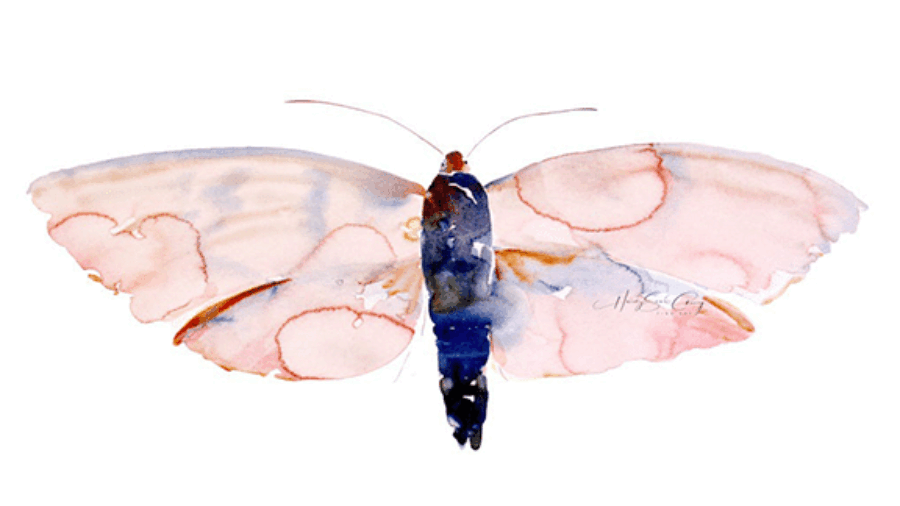
When we learn to look, two things happen. First, we discover that creation is very good. I am reminded of my time at A Rocha France, painting moths and finding the beauty and intricacy of these often-overlooked insects. Sometime later, at L’Abri in Switzerland, this experience was mirrored in my workshop with students as I asked them to closely observe and draw moths at various stages of their lifecycle. The act of looking and creating was utterly transformative, with one student sharing that three days earlier, she would have killed a moth without a second thought. They had learned to cherish – to see the ‘very goodness’ – of this tiny piece of creation. The artist’s role is to teach people to see, and when we learn to see, we respond with love.
The second thing that happens is that God is revealed in creation – ‘The heavens declare the glory of God.’ When I have sent my students into nature to practice looking, God has spoken to them as He so often speaks to me. The artist becomes a storyteller. As I consider, ponder, and discover the depths of God as revealed in creation, my art tells these stories.
My friend, a composer, tells me that for her, the beauty of music is that it unfolds through moments in time. As an artist, I find great beauty in art’s ability to hold countless brushstrokes, hours of effort, and corresponding or even contradictory ideas all together, at once, on the same paper. Meaning is so powerfully received when it is rooted in the complexity of life; as the Psalmist wrote, ‘he makes the valley of Achor a gateway of hope.’ Not the valley of abundance or ease, but the valley of trouble. Art holds space for mystery and paradox in a way that is unique to this discipline and has been explored within Christian worship for centuries if not millennia.
‘Then Moses said to the sons of Israel, “See, the Lord has called by name Bezalel the son of Uri, the son of Hur, of the tribe of Judah. And He has filled him with the Spirit of God, in wisdom, in understanding and in knowledge and in all craftsmanship; to make designs for working in gold and in silver and in bronze, and in the cutting of stones for settings and in the carving of wood, so as to perform in every inventive work.”’ Exodus 31:1-5
The first time God’s Spirit is recorded as filling a person is to give an artist wisdom, understanding and craftsmanship. This passage also speaks of what God finds beautiful – our worshipful response to the work of his hands, the land beneath our feet. Not any land; the pomegranates and grapes made of gold were meaningful and fruitful in their culture, time, and place.
The question of how we can incorporate art into worship is not answered from a distance but rather within a specific community. This can sometimes be lost in our increasingly global world. Who are your artists? What land do you inhabit? What is significant, worshipful, and beautiful in your church community?
This passage also speaks of the invitation and role of individual artists, for Bezalel was called by name.
If the church, in a world full of industry and agenda, can create spacious places for artists to flourish, they will become the storytellers, teachers, and hope-bringers God has designed them to be. They will bless the body and creation with their ability to look and respond. Art is not just something God uses but sits right at the center of His rich and full design for worship.
Finally, I am reminded of two stories. The first was the Easter Vigil at my church, Church of the Cross, Boston, where artists, musicians, chefs, florists, and others filled the church with God’s creation and our worshipful response to Him. I saw in the details artistic coincidences that are impossible to orchestrate apart from God’s pleasure, intention, and presence within our art. The second was an exhibition of my work at Waterfall Gallery, NYC, one of the busiest and most secular cities on earth. Many at the exhibition saw paintings pleasing to the eye, but those who had eyes to see saw the message of reconciliation and hope within my floral collection, ‘Beauty from Ashes’. The call to the visual artist is to see and worship, build up the body, and finally, be hope-bringers to our despairing and complex world, by speaking of God’s care – for us and all of creation.
This blog was republished with permission from Heidy’s Substack and is an excerpt from Worship & Creation: A Digital Guidebook by A Rocha USA (2024). You can download the full guidebook for free here.
Other Articles
The conception of A Rocha Singapore
What would an engineer and an economist-by-training know of nature conservation, much less about helping found a Christian conservation non-profit organization in Singapore? Meet Phillip
Conservation Certificate Cohort 1: The Experience
Almost a year since its launch, the Conservation Certificate’s first cohort will graduate by the end of July. Read about their transformational experiences Almost one
Forty years of experiencing biodiversity and beauty in the Florida Keys, USA
Where faith, science and coral reefs meet. Reflecting on decades of diving in the Florida Keys, this article explores how science and theology can work
